Most of the homes we walk into are not badly decorated. They are simply unfinished in a particular way: the paint was chosen in a hurry, the lighting was whatever the builder left behind, and the furniture was bought to fill a gap rather than to solve a problem. Fixing that does not require a full renovation. It requires a small number of deliberate decisions, made in the right order.
Below are the ideas our interior team returns to again and again, because they work in ordinary family homes — not just in photographs.
Warm minimalism: calm, not empty
Minimalism has softened. The cold, gallery-like rooms of a decade ago have given way to warmer spaces that still avoid clutter but feel lived in. Think natural materials, rounded edges, fewer objects chosen with more care.
The practical test is simple. Stand in the middle of the room and ask what you actually look at. If the answer is "nothing", the room is empty. If the answer is "everything", it is busy. A well-decorated room has a handful of things worth looking at and plenty of quiet space around them.
- Choose a small number of larger objects rather than many small ones.
- Leave breathing room on shelves and surfaces — negative space is a material too.
- Let one wall be a feature and let the rest recede.
Layered texture instead of more colour
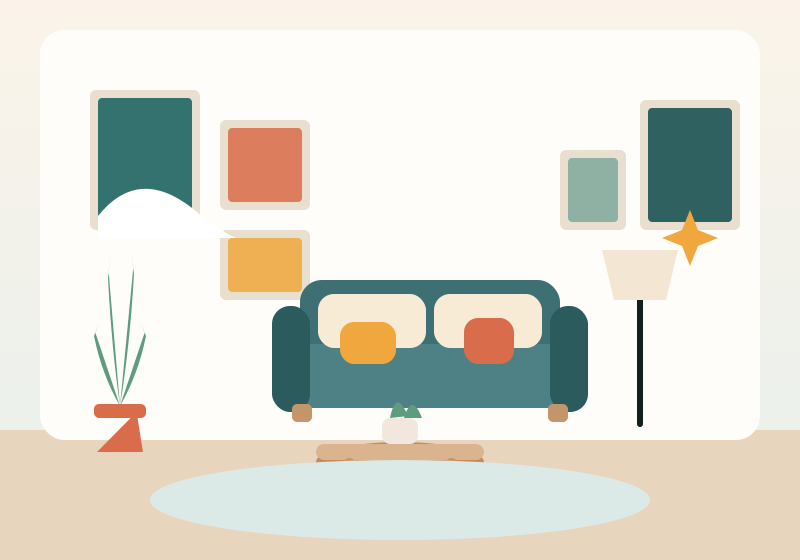
Texture is the most underused tool in decorating. A neutral room with a boucle cushion, a linen throw, a raw wood table, a ceramic lamp base and a woven rug reads as rich and considered, even though every item is a similar tone.
If a room feels flat, it is almost always missing texture — not more colour.
Build texture in layers from the floor up: rugs, upholstery, woods, ceramics, metals, plants. When you vary the surface, the eye keeps moving and the room feels generous even when it is compact.
Lighting that does the heavy lifting
Overhead lighting alone is the single most common reason a decorated room feels disappointing. Good lighting design uses several sources at different heights so the room can be tuned to the time of day and the mood.
- Ambient — a soft general layer, often from a dimmable ceiling fitting or uplighters.
- Task — directed light for reading, cooking, homework and hobbies.
- Accent — pools of light on artwork, plants or architectural detail.
- Decorative — the fittings themselves: a sculptural pendant, a table lamp, candlelight.
Warm light temperatures suit living rooms and bedrooms; cooler, brighter light suits kitchens, bathrooms and anywhere you do detailed work. Dimmers are the cheapest upgrade in the whole of interior design.
Colour used with confidence
Deep, saturated colours have moved out of the accent wall and into whole rooms. A room painted in a rich teal, a warm ochre or a soft clay pink feels enveloping rather than dark, provided the rest of the scheme is calm.
A reliable approach is the proportion rule: a dominant neutral, a secondary supporting colour and a small amount of something bold. When you are nervous about a strong colour, introduce it through items you can change cheaply — cushions, art, a chair, a lamp — and live with it before committing to paint.
Flexible rooms that earn their keep
Modern homes rarely have a spare room to waste. The most useful interiors we design are the ones that change job during the day: a dining table that becomes a homework desk, a corner that becomes a reading nook, a guest room that is also a home office.
Flexibility comes from a few practical choices: furniture on castors or lightweight enough to move, lighting that covers more than one activity, storage that hides the work away, and a layout that leaves a clear central route through the room.
Storage that disappears
Clutter is rarely caused by owning too much. It is caused by having nowhere to put what you own. Before you buy another storage box, look at the closed storage you already have — is it in the right room, at the right height, and divided sensibly inside?
Built-in joinery, benches with lids, window seats with drawers and full-height cupboards all hide everyday mess behind a door. Painted the same colour as the walls, they effectively vanish from the room.
Where to start in your own home
If you only do one thing this season, do this: edit one room completely. Take everything off the surfaces, put back only what you use or love, then look at the room with fresh eyes. Most people discover they need less furniture, better light and one genuinely good piece rather than a dozen small ones.
If you would like help, our Home Decor and Interior service starts with a walk-through and a conversation about how you actually live. We plan the layout, the palette, the lighting and the finishing touches — and we can either supply everything or work alongside pieces you already own.