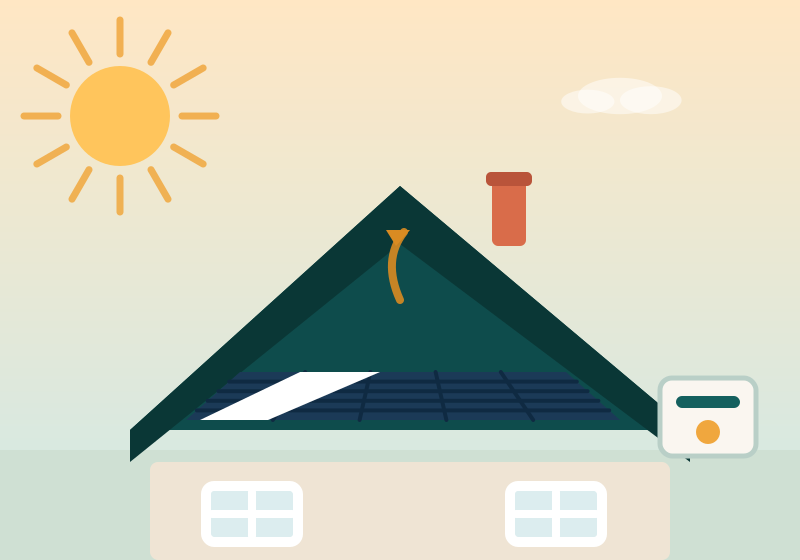
A roof replacement is the most disruptive, most expensive and least glamorous job a homeowner can commission. It is also one of the few that protects everything else you own. Adding solar on top of a tired roof is the classic mistake: the panels will almost certainly outlive the covering beneath them, which means removing and refitting the entire array later.
This guide covers how to read the condition of your roof, how to choose materials for a Wisconsin climate, and how to sequence roofing and solar work so you only pay for the disruption once.
Reading the condition of your roof
You do not need to climb a ladder to know whether your roof needs attention. Walk around the outside of the house with binoculars and look for these signals:
- Curling, cupped or missing shingles — the most visible sign that the covering is at the end of its life.
- Granules in the gutters — a gritty residue after rain means the protective surface is wearing away.
- Daylight or staining in the attic — check the underside of the roof deck on a bright day, and again after heavy rain.
- Sagging or soft spots — a dip in the roofline can indicate a structural problem in the decking or rafters.
- Flashing and valley damage — the joints around chimneys, vents and skylights fail long before the field of the roof does.
None of these automatically mean a full replacement. A well-maintained roof can often be repaired rather than replaced, and a good roofer will tell you so. What matters is that someone competent looks at it before you commit budget either way.
Choosing materials for our climate
Wisconsin gives roofs a hard time: heavy snow load, freeze-thaw cycles, ice dams and long periods of wind-driven rain. Material choice should reflect that rather than a brochure photograph.
- Architectural asphalt shingles — the common choice, offering good value and a wide range of profiles. Look for impact-resistant and high wind-rated options.
- Standing seam metal — excellent at shedding snow, very long lived, and quieter than people expect once the deck and underlay are correct.
- Clay or concrete tile — beautiful and durable, but heavy; only appropriate where the structure was designed for the load.
- Natural slate — a century-long material that requires a specialist installer and a structure to match.
Whatever the finish, the parts that actually keep water out are hidden: the deck, the underlay, the ice and water shield at the eaves and valleys, and the flashing. Ask your roofer to talk you through those layers, not just the colour of the shingle.
A roof is a system. The visible covering is only the part you happen to see from the street.
Ventilation and insulation come first
Ice dams are almost always a ventilation and insulation problem rather than a roofing problem. Warm air escaping into the attic melts snow on the roof surface, and the meltwater refreezes at the cold eaves, backing up under the shingles.
Before a re-roof, it is worth having the attic assessed. Balanced intake and exhaust ventilation, together with proper insulation and a sealed attic floor, will extend the life of the new covering and reduce the energy the house needs. It is far cheaper to correct while the roof is already off.
How a solar upgrade is actually specified
Solar is not one product bolted to a roof; it is a small power station designed around how your household uses electricity. A sensible specification covers:
- An energy assessment — a year of usage, when you use it, and what you might change.
- Shade and orientation analysis — which roof planes are genuinely productive, and which should be left alone.
- Array sizing — matched to your consumption and your available roof area, not to a sales target.
- Inverter and monitoring — the component most likely to need attention, so choose a good one.
- Battery storage — optional, and genuinely useful if you want backup during outages or want to shift usage away from peak pricing.
- Structural check — confirming the rafters and deck can carry the additional load and the mounting hardware.
Ask for the production estimate in writing, along with the assumptions behind it. A credible installer will happily explain the difference between the sunny-day figure and the annual average.
The order of work that saves you money
If both jobs are on your list, the sequence matters enormously. Our recommended order is:
- Assess and correct attic insulation and ventilation.
- Complete any structural repairs to the roof deck.
- Replace the roof covering, underlay and flashing in full.
- Install the solar array and its mounting on the new roof.
- Add the inverter, monitoring and any battery storage indoors.
- Arrange inspection, utility interconnection and commissioning together.
Doing it in this order means the solar mounting is fixed to a roof with decades of life ahead of it, and it means one set of scaffolding, one skip and one disruption to your household rather than two.
Permits, paperwork and the utility
Roofing and solar both involve permits and inspections, and solar additionally requires an interconnection agreement with your utility. The paperwork is not difficult, but it is easy to underestimate how long the approval stages take.
Build those timelines into your plan, and make sure somebody is clearly responsible for each application. When we manage a combined roofing and solar project, we coordinate the permit applications, the inspections and the utility paperwork so you are not chasing several different organisations.
Getting started
Begin with a survey rather than a quotation. A proper survey tells you whether the roof can be repaired, whether the structure can take panels, which roof planes are worth using, and what the realistic sequence and budget look like. Only then does a price mean anything.
If you are weighing up a roof, a solar array or both, our Roofing Upgrade and Solar Upgrade teams work together on exactly this kind of project. Get in touch and we will arrange a walk-through of your property.